Parasite Testing Price List
To Our Valued Partners and Clients,
Medic Sai Gon Diagnostic Clinic is pleased to present the list of our Parasite Testing Packages as follows:
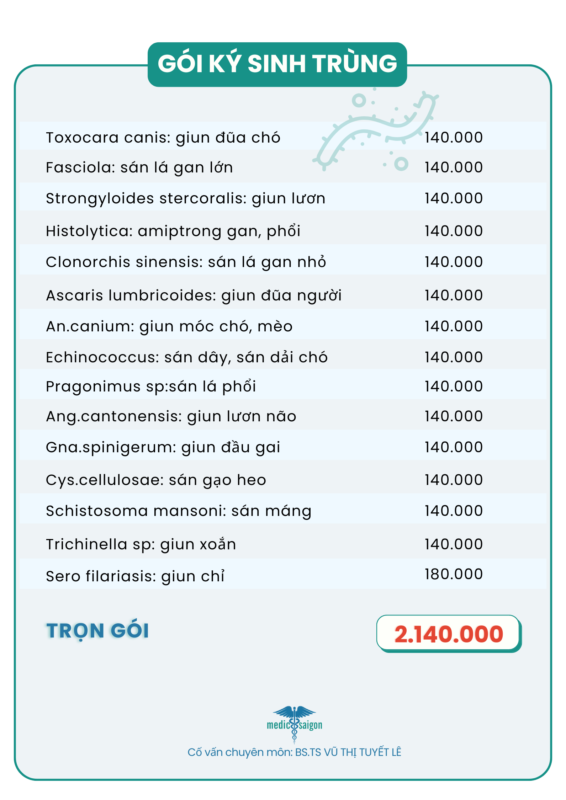
Parasite Testing Price List
“Parasite testing” has become a widely discussed topic recently. This is largely due to numerous reported cases of children contracting worm and parasite infections after consuming unsafe or poor-quality food. So, what exactly is this test, and when should it be performed? These are common questions raised by many parents and individuals. Let’s explore the answers in the article below.
1. Why is the demand for parasite testing increasing?
Currently, many food sources are of unknown origin and fail to meet food safety and hygiene standards. Coupled with unscientific dietary habits and heavily polluted living environments, this has created favorable conditions for various parasites to invade the human body.

Why is the demand for parasite testing increasing?
Recently, outbreaks of pork tapeworm larvae have appeared in several provinces across the country. There have been many reported cases of children contracting pork tapeworms after consuming contaminated food. Furthermore, the unclear origins of pork in the market have caused widespread public concern. Consequently, parasite testing has become one of the most highly requested services by the public at medical facilities today.
What exactly is parasite testing?
However, not everyone fully and correctly understands what parasite testing entails. Testing is a diagnostic method for microbial and parasitic infections, designed to provide patients with the most accurate results regarding their current health condition.
Often, many people assume that parasitic diseases are diagnosed solely through blood tests. However, it is not that simple. To definitively determine whether a patient is infected with a parasite and to evaluate the extent of the infection, a doctor may order several different types of tests. For example, when checking for parasites in the intestinal tract, a stool examination must be utilized.
May you need: What are the symptoms of a worm infection?
2. When should you get tested for parasites?
There are many clinical symptoms caused by parasitic infections. Among them, itchy skin and allergic reactions are signs indicating that the infection may have already progressed to a more severe stage. This is especially true if you experience intense itching at night, red rashes appearing in patches across the body, or localized itching in specific areas.
Therefore, if you suffer from persistent itching, it is highly recommended to seek medical attention to determine the exact cause. Certain types of blood-borne worms and flukes can trigger these skin allergies and itching in patients.
Patient signature duplication in common cases
3. Several methods for parasite testing
Generally, there are two methods for diagnosing the disease: clinical diagnosis and laboratory diagnosis. Each method is specifically explained as follows:
3.1. Clinical diagnosis
Through the body’s physical manifestations, the doctor diagnoses your illness. However, people infected with parasites often do not have clear or specific symptoms. Some conditions even resemble other diseases, making clinical diagnosis often difficult and uncertain. To definitively confirm the disease, testing is required.
3.2. Laboratory diagnosis
Following the clinical examination step, testing methods are essential to supplement and confirm accurate results. Through testing various types of clinical specimens, parasites can be detected, such as:
- Examining peripheral blood smears can detect blood parasites (if any) such as: Malaria parasites, lymphatic filariasis…
- Serum immunological testing in the blood can detect many types of parasites. Because when parasites invade the body, the body will mount an immune response by producing specific or non-specific antibodies. These are IgG/IgM for each type of parasite, such as: Roundworm IgG, Pork tapeworm IgG, Pork tapeworm IgM, Candida IgG, Filaria IgG… Almost a majority of parasites can be tested for IgG/IgM in the blood for initial screening.
- Stool examination of the patient to find protozoa, threadworm larvae, and helminths.
- Histopathological testing: biopsies can detect certain parasites such as the pork tapeworm and beef tapeworm groups…
- Direct wet mount testing or PCR can detect some types of parasites. This is done using specimens such as: biological fluids, excretions, pus, vomit…
- Direct wet mount testing from keratinized cells (nails, skin scales,…).
- Testing intermediate hosts causing the disease. Through daily eating and living habits, there may be intermediate sources causing the infection for you such as shrimp, fish, crabs, flies, vegetables, soil, water…
- In addition, there are several other tests that provide excellent support in diagnosing parasitic diseases, such as: a complete blood count (CBC) to check for elevated eosinophils, liver enzymes…
See more: 44,60,90 – Allergen Screening Panel
4. Notes when drawing blood for helminth testing
A common question asked by many people is whether fasting is required for the test. Blood tests for parasite screening usually do not require fasting. You can have your blood drawn at any time that is convenient for you, whether in the morning or afternoon. For malaria parasite testing, it is best to draw blood when the patient is experiencing a fever. Especially in suspected cases of lymphatic filariasis infection. Blood must be drawn between midnight and 2 AM to have a high probability of detecting the parasite.
In addition, you also need to visit reputable testing centers to ensure accurate results. Currently, there are many hospitals capable of performing these tests. However, you need to choose a facility fully equipped with modern medical technology. At the same time, it must have a professional team of doctors and medical staff.

MEDIC SAI GON DIAGNOSTIC CLINIC
97 Hai Phong, Hai Chau, Da Nang.
Hotline/WhatsApp: 0914 496 516 – 0236.3822866